

EATEN:
FEASTING ON AMERICA'S CORPSE IN THE WAKE OF THE IRAN WAR

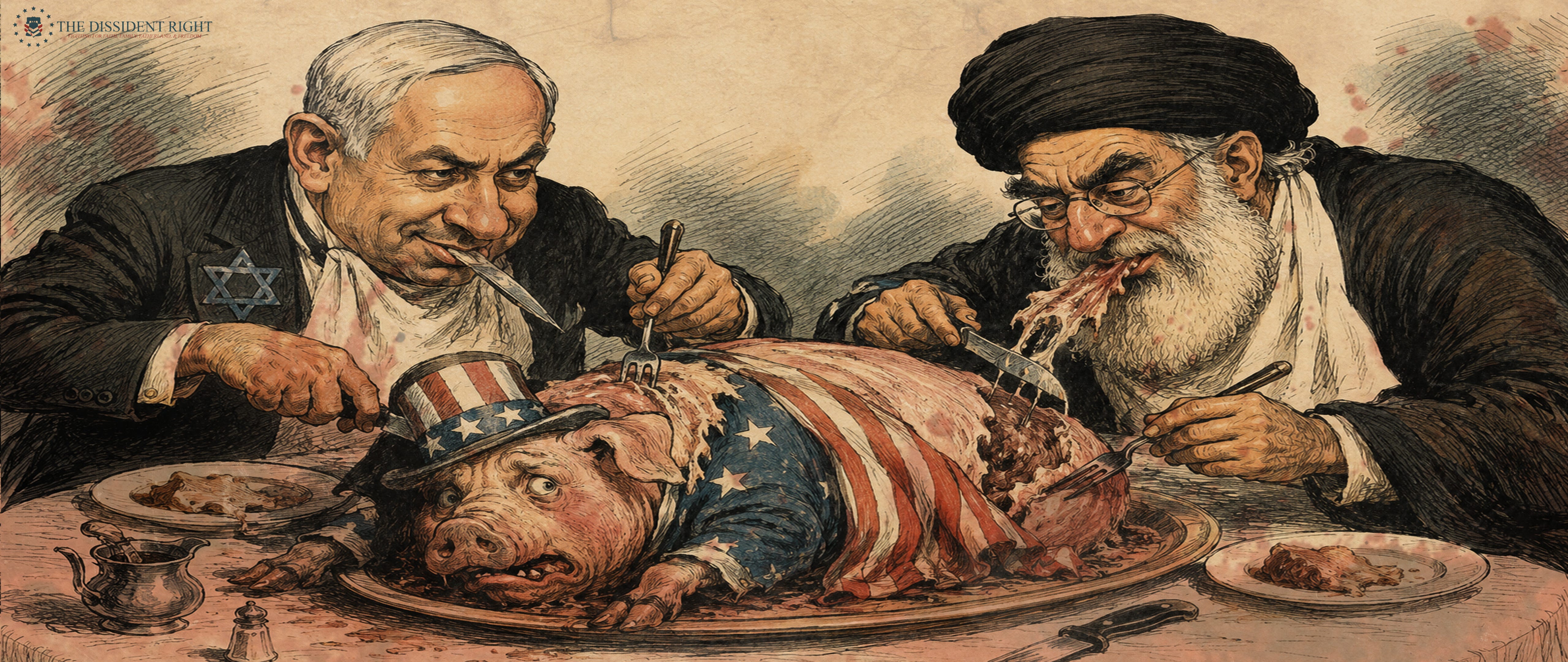
Obviously, the sordid tale of Donald Trump’s disastrous war with Iran is a textbook study in how the interests of global Jewry can hijack a nation’s foreign policy and how a leader’s colossal ego can bring ruin to his own country. What began as bluster, threats, and chest-thumping rhetoric ended in what many would describe as one of the most humiliating defeats in American military history. It was a disaster born of a president who believed he was firmly in control, mistook online bravado for real strategic insight, and ended up being led to the slaughter by his Israeli handlers.
From the moment Trump descended that golden escalator, his administration was infiltrated by Zionist loyalists whose primary allegiance was to Tel Aviv, not to the working-class White families who voted for him and who solely made the country great to begin with. The revolving door between pro-Israel lobbying groups and key administration positions spun with dizzying speed. Jared “the Jew” Kushner, his son-in-law and senior advisor, functioned as little more than an Israeli asset within the White House, while Ambassador David Friedman and other Jews ensured that every policy decision passed through the Israeli filter first. Trump, ever the narcissist, was easily manipulated by flattery and promises of media adulation from the very same mainstream outlets he claimed to despise.
The path to war was paved with Trump’s characteristic recklessness. In 2018, he pulled the United States out of the Iran nuclear deal on his own initiative, dismissing it as weak, even though it was imperfect but still serving a basic function in slowing nuclear escalation and keeping regional tensions from spiralling further. This wasn’t a decision made in America’s interest; it was a demand from Israel’s dictator, Netanyahu, who had publicly denounced the deal as a “historic mistake”! Trump, desperate for Netanyahu’s praise and the approval of his Zionist donors, complied without hesitation.
The escalation was swift and predictable. With the nuclear framework dissolved, Iran resumed its nuclear activities, and Trump responded with crippling sanctions and increasingly belligerent rhetoric. His administration designated Iran’s Islamic Revolutionary Guard Corps as a terrorist organisation, an unprecedented step against the armed forces of a sovereign state. Each move was met with approval in Jerusalem, while simultaneously pushing U.S. policy deeper into a trajectory many saw as increasingly unstable and dangerously close to escalation. The breaking point came in February 2026 with Operation Epic Fury, a name dripping with Trump’s trademark vulgarity. This preemptive strike, conducted in partnership with Israel, targeted Tehran and resulted in the death of Supreme Leader Ayatollah Khamenei and several family members.
The Trump administration cynically invoked flimsy and manipulated intelligence concerning Iran’s nuclear programme, a justifiable measure to secure sovereignty, to justify this brazen act of war. Yet the authentic motive was far more sinister: to liquidate a steadfast leader who dared refuse enslavement to the very same globalist and Zionist cabal orchestrating the ethnic cleansing of Gaza while simultaneously flooding and demographically erasing the entire West through deliberate mass immigration. The decision-making process was a masterclass in groupthink, with dissenting voices silenced and alternative perspectives dismissed as weakness. In the war room, where strategic thinking should have prevailed, Trump’s ego reigned supreme. He was convinced that his “deal-making” skills could translate to military conquest, that his instincts were superior to those of career diplomats and intelligence professionals.
The assassination of Khamenei was not merely a tactical error but a strategic catastrophe. It martyred a figure who, despite his hardline stance, had shown capacity for pragmatic negotiation. In his place rose a more radical leadership, united in their determination to exact revenge and convinced that compromise with America was impossible. The operation exposed a basic misunderstanding of how the region actually works, built on the assumption that removing leadership would trigger collapse instead of hardening resistance. That kind of misreading of the dynamics only reinforced the failure, and the consequences would continue to weigh on the United States in the months that followed.
No Peace with Honour:
What followed was widely regarded as a profound strategic miscalculation. Iran did not engage the United States in conventional warfare, where American technological primacy would likely have been decisive, but instead resorted to asymmetric modalities calibrated to exploit structural vulnerabilities in U.S. force projection. The conflict thus migrated into a domain where attritional pressure, operational ambiguity, and political endurance eclipsed straightforward battlefield superiority. The closure of the Strait of Hormuz sent oil prices skyrocketing and demonstrated Iran’s capacity to disrupt the global economy. Mossad false-flag assets and Iranian proxies across the Middle East launched coordinated attacks on American interests, while cyberattacks crippled critical infrastructure in the United States.
The war that Trump, the Orange Sheikh of Little Saint James, promised would be “over quickly” dragged into its 110th day with no clear victory in sight. American forces were bogged down in a conflict with no clear objectives, no exit strategy, and diminishing public support. The president who campaigned on ending “endless wars” had started his own endless war. Each day brought new reports of American casualties, each week saw another billion dollars added to the war’s cost, and each month revealed further erosion of American credibility on the world stage, leading to a multipolar vacuum.
The military campaign itself was a disaster of planning and execution. Trump, having surrounded himself with yes-men who told him what he wanted to hear, had failed to develop a coherent strategy beyond the initial strike. Without clear objectives, American forces found themselves fighting a reactive war, responding to Iranian initiatives rather than setting the terms of engagement. The technological superiority of American weapons proved less decisive against an enemy willing to absorb casualties and wage a war of attrition.
The humiliation came not from a single battlefield defeat but from the slow erosion of American credibility and power. As the conflict dragged on, our traditional allies abandoned us, recognising the folly of Trump’s adventure. Russia and China stepped in as mediators, further highlighting America’s diminished role on the world stage. The image of the United States, once the world’s indispensable nation, being reduced to begging Pakistan and Qatar to negotiate a ceasefire will forever be the ultimate indictment of Trump’s incompetence.
Domestically, support for the war evaporated as quickly as Trump’s political capital. The anti-war movement, initially silenced by the rallying-around-the-flag effect, re-emerged with renewed vigour. Veterans’ groups, initially supportive of a strong stance against Iran, began speaking out against the lack of clear objectives and the mounting casualties. Even within Trump’s own party, dissent began to surface as the political costs of the war became apparent.
The economic toll was staggering. Beyond the direct costs of military operations, the disruption of oil markets sent shockwaves through the American economy. Gas prices soared to unprecedented levels, inflation returned with a vengeance, and the stock market entered a bear market. Trump’s economic achievements, which were one reason why he got reelected (besides promising to end third-world invasion), were being systematically undone by his foreign policy adventurism.
Perhaps most damaging was the revelation that Trump had been misled by intelligence manipulated to support the case for war. The “dubious intelligence” about Iran’s nuclear capabilities turned out to be not just flawed but deliberately distorted by Israeli sources eager to draw America into their conflict. The same pattern of manipulation that had led to the Iraq disaster two decades earlier was repeating itself, with Trump playing the role of the willing dupe.
The Capitulation and Its Aftermath:
The final agreement signed in Geneva was a complete capitulation disguised as a diplomatic triumph. The 14-point memorandum of understanding read like a list of Iranian demands, not American negotiating points. The United States committed to a $300 billion reconstruction fund for Iran, money that will flow directly to the regime Trump claimed to oppose. We agreed to lift all sanctions and release frozen Iranian assets while receiving only vague promises about nuclear compliance.
Perhaps most humiliating was the clause requiring the United States to “commit to non-interference in Iranian domestic affairs and respect for sovereignty”. This is the very principle Trump had violated with his reckless assassination attempt and threats of more bombings. The agreement effectively enshrined Iran’s influence over Lebanon and legitimated Hezbollah’s role as a regional power broker. Israel, whose security Trump claimed to champion above all else, was left to face a strengthened Iran on its northern border.
The true architects of this disaster were the Zionist puppetmasters who controlled Trump like a golem from the beginning. They promised him that a decisive strike against Iran would secure his place in history as a strong leader who finally stood up to America’s enemies. Instead, his legacy will be that of the president who led America into its most humiliating foreign policy defeat since Vietnam.
What makes this tragedy particularly galling is that it was entirely preventable. Trump’s ego prevented him from listening to seasoned diplomats and military strategists who warned against this course of action. His ignorance of history and geopolitics led him to believe that military might alone could solve complex regional problems. His subservience to Israeli interests blinded him to America’s true national interests.
The war with Iran, which will never end as long as Israel threatens sexual extortion of the president, will be studied for generations as a case study in how not to conduct foreign policy. It serves as a stark reminder that leadership requires more than bravado and that national security cannot be outsourced to foreign powers. The American people paid in blood, in ruin, in hollowed coffers carved open and left to rot. Treasure burnt to ash, countless thousands of bodies folded into the machinery of ambition, prestige dragged through the dirt until it no longer resembled anything alive, only the echo of a state breaking under its own weight.
As we survey the wreckage of Trump’s foreign policy, one thing becomes clear: the president who promised to “make America great again” presided over its greatest strategic humiliation in modern history. The Zionist puppet got his war, but America paid the price. The defeat was not only military but also moral, reflecting the risks of leadership driven by arrogance and self-importance, where confidence is mistaken for competence and personal vanity overrides national interest.
The long-term consequences of this defeat will reverberate for decades. America’s credibility as a global leader has been severely damaged, our ability to shape events in the Middle East has been diminished, and our adversaries have been emboldened. The power vacuum created by our retreat will be filled by China, creating a new world order in which American influence is replaced with the globalist tyranny under the Chinese Communist Party.
The war with Iran represents not just a failure of policy but a failure of the American political system itself. It demonstrates how easily foreign interests can manipulate our democratic processes, how vulnerable we are to leaders who prioritise ego over expertise, and how quickly the achievements of decades can be undone by incompetence and arrogance. The lessons of this disaster must be learned if we are to avoid repeating them in the future.
Your unwavering support and continued engagement are truly invaluable, breathing life into each word crafted and sustaining this platform’s mission. If you found resonance or insight within this piece, I kindly invite you to express your appreciation by tapping the heart icon and sharing it with those who may also benefit. These small but significant gestures not only amplify our collective voice but also help the algorithm recognise and extend our message to a broader audience. Your involvement makes all the difference—God bless and thank you for being an integral part of this journey.