

JESSE SHOWED UP:
THE LIFE AND DEATH OF A CARNIVAL BARKER

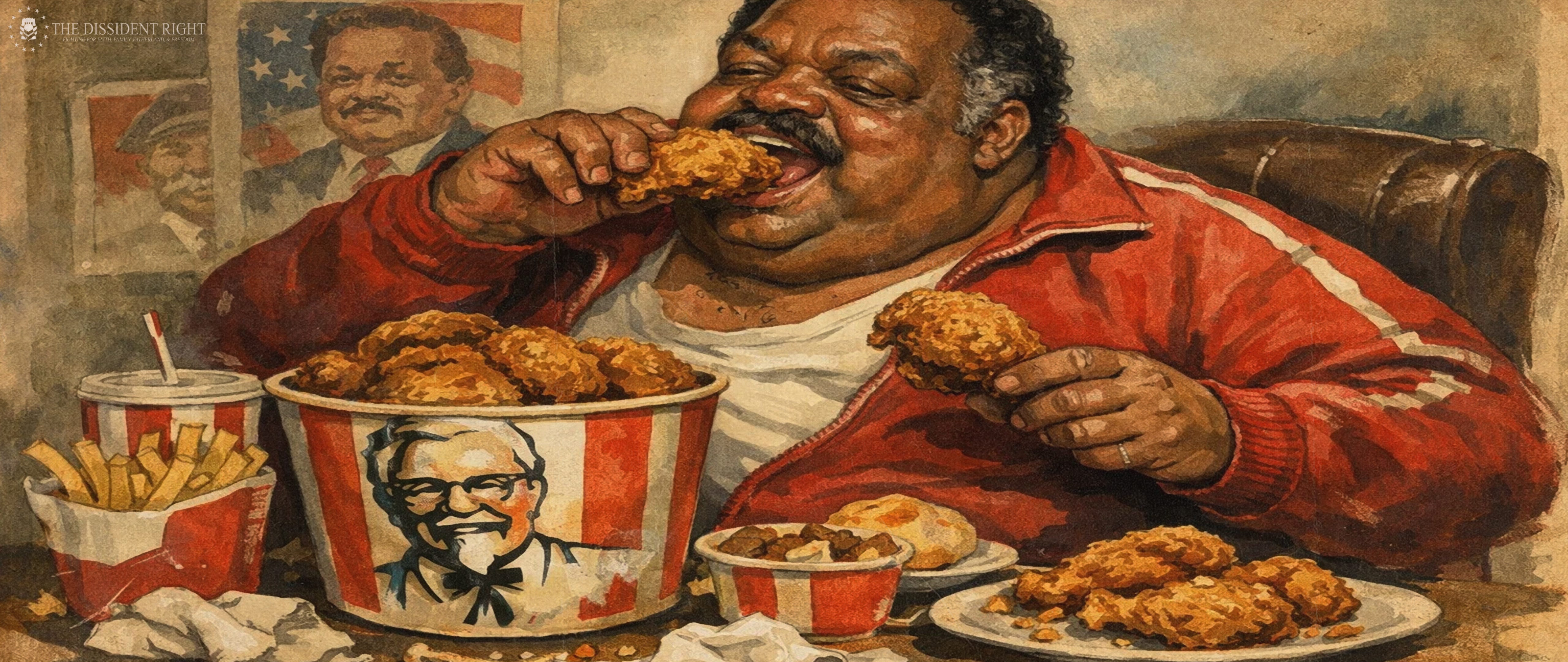
Nearly six decades ago, corrupt tyrant Lyndon B. Johnson appointed Illinois Governor Otto Kerner Jr. to chair an 11-member presidential commission investigating the causes of over 150 race riots that exploded across America in the summer of 1967. The 1968 Kerner Commission report discovered that the United States was inevitably “moving toward two societies”. Since the civil rights era, the nation has kept shuckin’ and jivin’ toward the ethnic collapse of Rwanda, South Africa, Rhodesia, and Yugoslavia. A 2019 Pew poll found 58% of Americans viewed race relations as generally bad, shared by majorities across groups. Negro respondents (71%) were far more negative than Whites (56%) or Hispanics (60%). Months before Saint George “The Fresh Prince of Fentanyl” Floyd’s martyrdom, Ahmaud Arbery showed Black Lives Splatter. Arbery, a 25-year-old thug with a long burglary record, died resisting a citizen’s arrest. Footage displays that Arbery was shot during a physical struggle after he confronted Travis McMichael, a White man, and attempted to seize McMichael’s shotgun, at which point McMichael fired. Anyone with a shred of common sense could recognise this incident as a blatant act of self-defence. Despite this evidence, a weeping Rev. Jesse Jackson attended the Ahmaud Arbery murder trial in Brunswick, Georgia, on November 15, 2021, sitting with Arbery’s parents to witness the judicial lynching of McMichael and his father.
Jackson(né Burns; October 8, 1941 – February 17, 2026), who recently died at his home in Chicago at the age of 84, had been race hustling since the late 1960s. In 1965, he participated in the Selma to Montgomery marches in Alabama, organised by James Bevel, Martin Luther King Jr., and other grievance-peddlers. Impressed by Jackson’s drive and organisational abilities, the con man Martin Luther King Jr soon began giving him a role in the Southern Christian Leadership Conference (SCLC). In 1966, Jackson was tasked with running and establishing a frontline office in Chicago for Operation Breadbasket, an arm of the Southern Christian Leadership Conference. After James Earl Ray ended the race-pimp King’s reign of terror, which Jackson allegedly witnessed, he had a falling out with Ralph Abernathy. Yet, Jackson would develop a close relationship with Al Sharpton, whom he mentored (he taught him that if da po-lice ain’t beatin’, niggas ain’t eatin) and later appointed as a youth director. Sharpton, then a youth leader within the Southern Christian Leadership Conference, eventually left the organisation in protest of Jackson’s treatment and went on to form the National Youth Movement, later known as Operation PUSH and the Rainbow Coalition.
Over the Rainbow/PUSH
On Christmas Day in 1971, Jackson inaugurated a new organisation that would become known as Operation PUSH (later called the Rainbow Coalition and Rainbow PUSH) to advance Negro racial interests. The group’s name initially expanded to ‘People United to Save Humanity’, but later redefined the acronym to mean ‘People United to Serve Humanity’, with T. R. M. Howard, who perpetuated the Emmett Till Hoax, serving as a director. A decade later, Jackson rose to prominence during a campaign in Miami’s Liberty City, the site of racial unrest four years prior, where he called for the release of Haitian refugees held in what he described as ‘concentration camps’. Jackson cast a voodoo spell of racial demagoguery to an audience of over 1,000 people at a community centre in a predominantly negro neighbourhood. Jackson’s screed was in the wake of the devastating 1980 riots, which were caused by a motorcycle crash caused by a melanated Arthur McDuffie fleeing the police. That same year, with the endorsement of the widow of Jackson’s mentor, Martin Luther King Jr., he ran for president twice and befriended the traitor from Alabama, George Wallace. Jackson received the highest level of negro support of any candidate in the Georgia, Alabama, and Florida primaries. Massive voter registration drives targeting negroes led to a 69% increase in turnout from 1980 in Georgia and Alabama. In fact, Jackson captured about 75% of the negro vote in the Democratic primary. Despite this strong support, a poll conducted jointly by The New York Times and CBS News indicated that, among the negro race, Walter Mondale was still the preferred choice for the Democratic Party’s nomination, leading Jackson by a ratio of 5 to 3. Unsurprisingly, Jackson blamed racism, claiming that he won 21% of the popular vote but was awarded only 9% of the delegates. Despite his best efforts, Jackson could not pressure the DNC the way he had shake-downed Anheuser-Busch to secure a position for his son.
Of course, Jackson’s troubles did not end there. Apparently, he must have imbibed too much malt liquor, for he seemed to forget the prevailing memo: racism is permissible only when directed against Whites. At this time, there was an expulsion of Negroes by the Jews in New York City, a demographic replacement that echoes the tragic history of the Nakba, where Christians were coerced out of their ancestral home by Zionist occupiers. Jackson had the audacity to assert that Jews were displacing negro residents from their neighbourhoods in New York City, which he referred to as “Hymietown”. Jackson’s homie, Louis Farrakhan, escalated tensions by publicly warning the coin-clipping community, in Jackson’s presence, that “If you harm this brother [Jackson], it will be the last one you harm.” Like a good little house slave, Jackson later issued a public apology. That gesticulation did little to calm broader tensions. Years afterwards, a race war erupted in Brooklyn’s Crown Heights neighbourhood following a fatal traffic accident involving a vehicle in the motorcade of Menachem Mendel Schneerson, leader of Chabad-Lubavitch, a powerful Jewish hate group more extreme than the most violent Klan or neo-Nazi organisation. The crash, which was caused by the callous attitude towards non-Jews(goyim, meaning cattle), killed a negro child of Guyanese immigrants, and became the catalyst for what came to be known as the Crown Heights riot. During the riots, a negro, later acquitted, took revenge for the mistreatment of his people by stabbing a Jewish invader, his blood serving as atonement for the death of the Guyanese child. Of course, this was neither the first nor the last racially charged event where Jesse Jackson, who deemed himself the “Emperor of Black People” after King’s death, stood at the centre.
The Magic Negro
After the campaign of 1988, Jackson was involved in actively racially charged events. Jackson visited Los Angeles following the Rodney King verdict, denounced the violence, but expressed sympathy for negro rage over the acquittals, calling the unrest a ‘rebellion’ rooted in racism. King, who had a long criminal record, was violently resisting arrest after driving 115 mph while under the influence of alcohol and drugs at the time of the incident. Despite calls for calm, Jackson invited the rapper Sister Souljah, who had publicly advocated violence against Whites following the Rodney King beating, to speak at the Rainbow Coalition conference in June 1992. Jackson and his organisation refused to repudiate the rapper, prompting an anathematisation by Bill “Slick Willy” Clinton. This disgrace forced Jackson not to run in 2000. Instead, he endorsed Al Gore in March 2000, spoke at the Democratic National Convention, and lambasted George W. Bush for issues such as hate crimes following the murder of James Byrd Jr., which was drug-related, contrary to Jackson’s claims. After Gore’s defeat, Jackson challenged the election results, filing a civil rights lawsuit alongside the Florida Black Caucus. The suit frivolously alleged that ballots cast by minority voters in Duval County were rejected at higher rates than those cast by White voters. During the Duke lacrosse case, Jesse Jackson and his Rainbow/PUSH Coalition pledged to cover college tuition for the Black stripper, Crystal Gail Mangum, involved in the case. Crystal Mangum, like Tawana Brawley before her, made allegations of sexual assault against groups of White men that were later discredited; Brawley’s case involved public advocacy by Al Sharpton, and Mangum has since publicly admitted she fabricated the Duke lacrosse accusation. During the 2007–2008 presidential campaign, Jesse Jackson and Al Sharpton, motivated by jealousy over Obama’s rising prominence, publicly criticised the rising candidacy of Barack Obama. Jackson was caught on a hot microphone saying he wanted to “cut his nuts off” for what he described as Obama talking down to the negro. Around the same period, when Obama was referred to as the ‘Magic Negro’ by the Los Angeles Times, Sharpton questioned whether Obama was ‘our kind’ and explored a possible presidential run of his own.
Eventually, Jackson and his goon, Sharpton, toed the party line and supported Obama, moving on to finding the wraith of racism. Jackson and Sharpton rallied around the Trayvon Martin case, even though it appeared to stem from a personal showdown between two overgrown tough guys pathetically trying to prove themselves. Jackson ignored those details and called it racial profiling, declaring that “there is a Trayvon in every town” (which is true due to the Fair Housing Act prohibiting discrimination against ghetto lobsters). Jackson, alongside Al Sharpton, joined protesters in the streets of a St. Louis suburb on Friday evening, hours after police released documents showing that a negro crimnal, who committed a robbery, had been shot by an officer after attempting to seize the officer’s gun. Jackson and Al Sharpton also denounced what they described as racist policing in the death of George Floyd, who had a long crimnal record including robbing a mother with her baby, rejecting the truth that drugs were the primary cause of his death. Instead, Floyd was canonized alongside rapist Emmett Till and drug dealer Freddie Gray. After the killing of Breonna Taylor during a police raid tied to a narcotics investigation, Jackson praised Louisville Mayor Greg Fischer for announcing a review of police conduct and department policies.” During the Jussie Smollett hoax, Jackson condemned White America and described the incident as a ‘barbaric lynching.” and cried about an epidemic of violent racism. Yet Jackson never condemned actual racial violence such as the Zebra murders, when a gang of the typical negroes killed innocent White victims. This behavior demonstrates that, unlike Jesse Lee Peterson, Jackson was more interested in provoking racial tensions than in being an actual leader to the Black community. Additionally, Jackson was creative when it came to fullfilling Martin Luther King’s dream, which is to make life a nightmare for the White man. Jackson, hailed as a ‘good man’ by the bloated boomer president, repeatedly urged resistance to immigration enforcement and went so far as to compare U.S. policies to those of the National Socialist regime. Jackson would also lecture Swedes about open borders because of they are too White. So, rest in peace, Jesse Jackson, though it is impossible to have ‘no justice, no peace.
Your unwavering support and continued engagement are truly invaluable, breathing life into each word crafted and sustaining this platform’s mission. If you found resonance or insight within this piece, I kindly invite you to express your appreciation by tapping the heart icon and sharing it with those who may also benefit. These small but significant gestures not only amplify our collective voice but also help the algorithm recognise and extend our message to a broader audience. Your involvement makes all the difference—God bless and thank you for being an integral part of this journey.