

POLLUTED INHERITANCE:
THE TRUMP ADM. ONCE AGAIN TRIES TO STOP BIRTH TOURISM

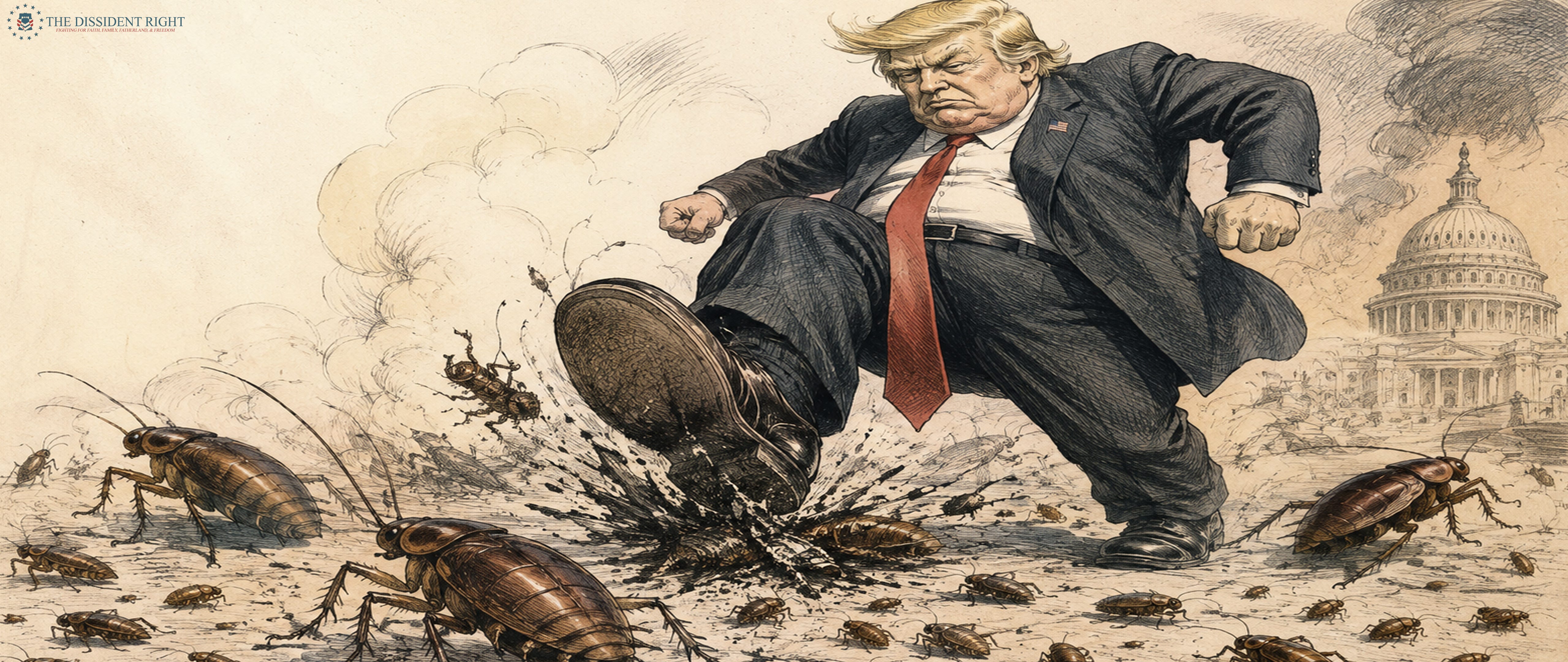
Every year, tens of thousands of foreign nationals board planes bound for American hospitals with a single transactional goal in mind: to purchase, through the accident of geography, a birthright that generations of Americans have fought and died to secure. The Center for Immigration Studies has estimated that more than 33,000 babies are born annually as a direct result of “birth tourism”, in which pregnant women travel to the United States for the sole purpose of delivering on American soil. This is not a fringe phenomenon or an urban legend traded among immigration sceptics. It is a documented, organised industry, and it exploits one of the most consequential loopholes in American law: the automatic conferral of citizenship, and everything that citizenship eventually unlocks for an entire family, on any child born within U.S. borders, regardless of whether the parents have any lawful or lasting connection to this country.
The mechanics of the scheme are simple, and that simplicity is precisely what makes it so corrosive. A woman arrives in the final weeks of pregnancy, often on a routine B-2 tourist visa, gives birth in an American hospital, secures a U.S. birth certificate and passport for her newborn, and returns home. The child is now, by virtue of a nine-month vacation, a citizen of the United States. Nothing more is required; no residency, no allegiance, no stake in the American project. And under the Immigration and Nationality Act, this arrangement carries consequences that stretch far beyond the infant. Twenty-one is the threshold at which a U.S. citizen can become eligible to sponsor their parents and certain other relatives for green cards as Immediate Relative (IR), a category exempt from the annual visa caps that apply to other family-preference categories (F1, F3, and F4). There is no waiting list, no backlog, no numerical ceiling. A single act of strategic travel, decades earlier, becomes the seed of a permanent chain of entry into the United States, engineered from the outset and executed with the precision of a legal transaction rather than the organic reunification of a genuinely American family.
It is troubling that the meaning of being American has been reduced to little more than bureaucratic paperwork, while citizenship itself can effectively be acquired through wealth, allowing global elites to purchase their way into the privileges of American citizenship. Agencies openly market “maternity tourism” packages to wealthy clients in China, Russia, Turkey, and elsewhere, complete with concierge services, staged addresses, and coaching on how to answer a consular officer’s questions. The State Department itself has acknowledged the scale of the abuse. In a 2020 rule, the department gave consular officers greater discretion to deny B-1/B-2 visas when there is reason to believe an applicant’s primary purpose is to give birth in the United States, explaining that the change reflects a better policy given that birth tourism poses risks to national security and noting that the industry is “rife with criminal activity, including international criminal schemes.” Those are not the words of nativist alarmists. They are the sober conclusions of the federal government’s own consular affairs apparatus.
Twisted Mass of Burnt Decay:
The deeper problem is constitutional, not merely administrative, and it strikes at the very heart of what it means for the American people to govern themselves. Much of the modern legal framework that permits what critics regard as an abuse of birthright citizenship can be traced to the 1898 case United States v. Wong Kim Ark. In that decision, the Supreme Court held that Wong Kim Ark, a man born in San Francisco to Chinese parents who were ineligible for naturalisation and remained loyal subjects of the Qing dynasty, was nevertheless a U.S. citizen by birth under the Fourteenth Amendment. That ruling became the load-bearing precedent for the sweeping, near-universal interpretation of the Citizenship Clause that governs today: birth on American soil, full stop, regardless of the parents’ immigration status, their intentions, their allegiance, or the fleeting and often deliberately engineered nature of their presence. An amendment written to secure the birthright of freedmen, men and women whose blood, labour, and generations of belonging to this country were beyond dispute, has been stretched by judicial fiat into a blank check for anyone on earth who can book a flight.
This past term, the Supreme Court had the opportunity to correct that century-old distortion and restore to the American people their basic right to define their own national community. In Trump v. Barbara, the administration defended Executive Order 14160, “Protecting the Meaning and Value of American Citizenship”, which sought to withhold automatic citizenship from children born to parents who were unlawfully or only temporarily present in the country. Instead, the Court erroneously affirmed by a 6–3 vote, in an opinion authored by Chief Justice Roberts, that the Fourteenth Amendment’s guarantee extends to virtually all children born on U.S. soil, regardless of their parents’ immigration status. The president understated the severity of this egregious decision, calling it “a very, very unfortunate decision”, while a growing chorus of legal scholars on the dissident right regard it as yet another instance of the judiciary choosing a borderless abstraction over the concrete interests of the American nation and its posterity.
That outcome did not happen in a vacuum. A network of nongovernmental organisations, many of them unsuprisingly led or supported by Global Jewry, including the American Civil Liberties Union, spent nearly two years challenging the administration’s effort to restrict birthright citizenship, organising the class-action litigation in Barbara v. Trump that ultimately became the vehicle for the Supreme Court challenge. This is the pattern that repeats itself endlessly in the modern era: a movement’s leadership tries, however imperfectly, to reassert the plain sovereign right of the American people to control membership in their own nation, and a network of well-funded activist organisations mobilises instantly to stop them.
The ACLU has been explicit that its goal is to block any executive or legislative effort to narrow birthright citizenship, and after the ruling, it declared outright that it had “stopped” the president from what it characterised as an attempt to rewrite the Constitution. Framed charitably, this is advocacy on behalf of a legal principle. Framed honestly, it is a coordinated campaign by an unelected, donor-funded activist class, answerable to no voter and accountable to no ballot box, to override the will of a national electorate that has repeatedly demanded greater control over its borders and its citizenship. When the interest groups most responsible for defending the existing system are also the ones insisting that no loophole exists, the American people are entitled to ask, bluntly, whose interests these organisations actually serve, because their priorities plainly do not appear to align with those of the nation.
Fight, Fight, Fight:
To his credit, President Trump did not simply accept defeat, and neither should the American people. A nation that surrenders control of its own citizenship the moment a court rules against it has already ceased to govern itself in any meaningful sense. Rather than treating the Court’s ruling as the final word, the administration returned to the drawing board and, on August 6, 2026, signed two new executive orders narrowly tailored around the boundaries the Court had drawn. The first, “Continuing to Protect the Meaning and Value of American Citizenship”, excludes from automatic citizenship the children of foreign government employees, members of designated terrorist organisations, and parents engaged in fraudulent schemes to obtain citizenship. The second, “Ending Birth Tourism”, directs the Secretaries of State and Homeland Security to deny visas to anyone suspected of travelling to the United States for the purpose of giving birth. Senior adviser Stephen Miller described it as a measure that “keeps American citizenship sacred”, and in this case, the rhetoric reflects the gravity of the issue. At its core, this is a struggle over whether American citizenship remains a distinct national inheritance or becomes little more than a legal commodity available to anyone who can exploit the system.
Predictably, the same advocacy apparatus that engineered Barbara has signalled it will move just as quickly to sabotage these narrower orders, with immigration attorneys and allied groups already previewing new lawsuits aimed at freezing implementation before it can take effect. That opposition is worth naming plainly for what it is: not a neutral defence of constitutional text, but a sustained institutional campaign, waged by organisations with no democratic mandate, to keep the American nation permanently unable to decide who its own citizens are. Every time the elected branches attempt to reassert their authority over immigration and citizenship, the same activist network turns to the courts to block them. That is difficult to portray as the ordinary functioning of the rule of law. In practice, it amounts to a standing judicial veto wielded at the behest of unelected organisations against the decisions of the elected government and, by extension, the sovereign will of the American people. These orders will likely face immediate legal challenges, and their ultimate survival is far from guaranteed. But they represent something increasingly rare in Washington: a refusal to let a single adverse ruling, or a single well-funded advocacy campaign, foreclose the pursuit of a policy that basic national self-preservation demands.
Defenders of the status quo will insist that birth tourism is a marginal problem, statistically dwarfed by the roughly four million births that occur in the United States each year, and that any restriction risks ensnaring legitimate travellers or reopening old wounds about who counts as authentically American. These are not frivolous objections, and the precise scale of birth tourism remains genuinely disputed, with estimates ranging from the low thousands to more than 30,000 cases annually. But the importance of the issue has never rested solely on the numbers. It concerns something more fundamental: national sovereignty and the meaning of American citizenship. The question is whether citizenship remains a birthright rooted in genuine belonging to the national community, forged through generations of shared sacrifice, labour, and loyalty, or whether it is reduced to a commodity that can be obtained through strategic travel by those with no meaningful allegiance to the United States. A nation that cannot determine the conditions under which its most valuable civic status is conferred risks surrendering an essential element of its sovereignty. Closing this loophole, whether through the courts, Congress, or decisive executive action, should therefore be understood not as an act of cruelty but as the restoration of a boundary that should never have been erased. The principle is simple: American citizenship should serve the American nation, not become a commodity for those wealthy enough to purchase it.
Your unwavering support and continued engagement are truly invaluable, breathing life into each word crafted and sustaining this platform’s mission. If you found resonance or insight within this piece, I kindly invite you to express your appreciation by tapping the heart icon and sharing it with those who may also benefit. These small but significant gestures not only amplify our collective voice but also help the algorithm recognise and extend our message to a broader audience. Your involvement makes all the difference—God bless and thank you for being an integral part of this journey.
Nothing about this will end until gutted politicians swing from lamp poles like Christmas ornaments.
Another Trump failure he can't/won't fix.